
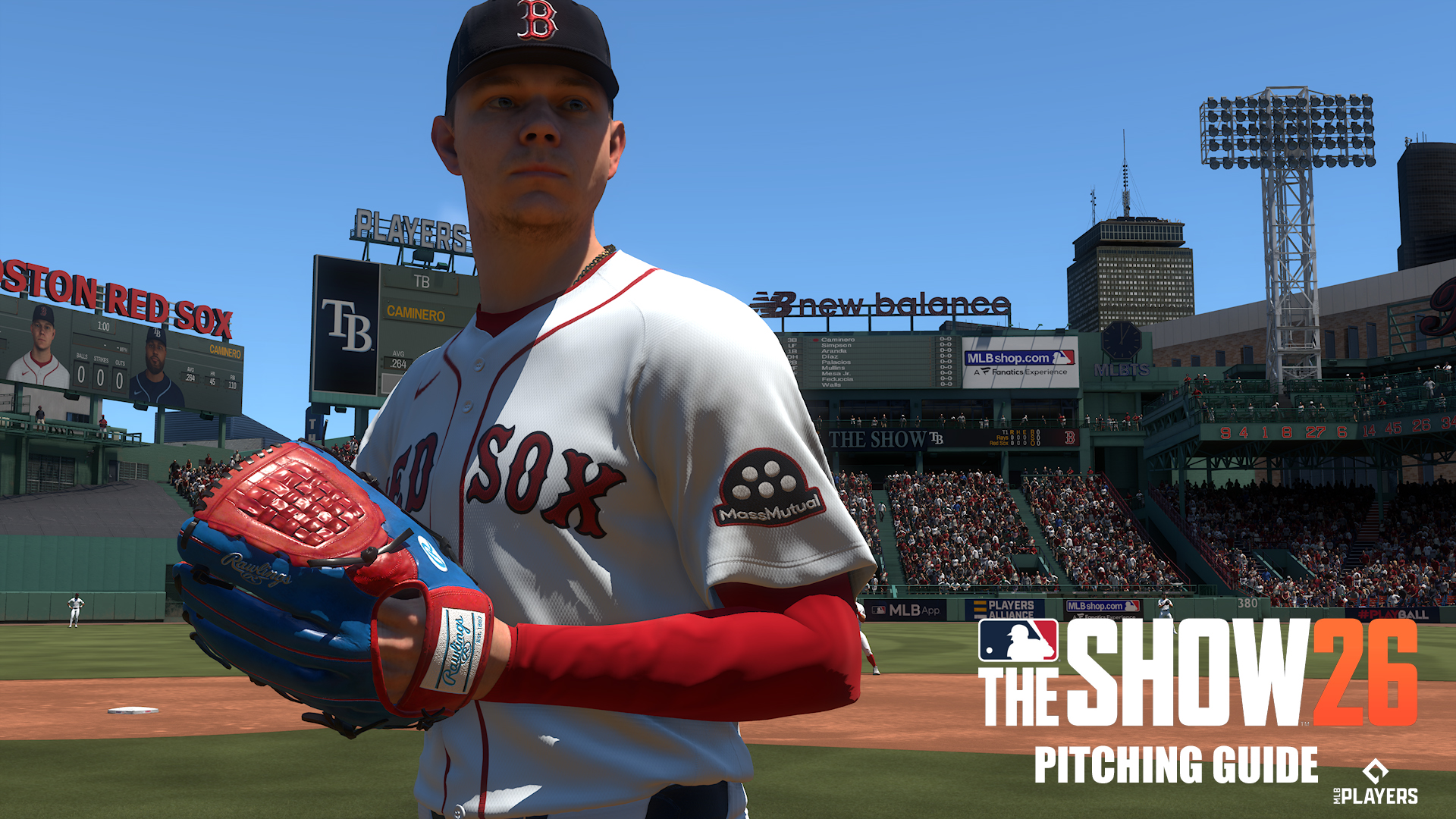
Pitching in MLB The Show 26 can be a mess, and even good players struggle with it. For those who have trouble on the mound, we can help, as we take a look at tips, plus recommended settings to get MLB The Show players in a groove on the mound.
Best Interface
Aside from Classic, the OG standard, there are four different interfaces: Meter, Pulse, Analog, and Pinpoint. Out of the four, Pinpoint is the best one in terms of accuracy and command.
Now, Pinpoint is the toughest to use, as it requires timing the right stick at the right speed, as well as moving it in the correct direction based on pitch. Four-seam fastballs are the easiest, as those simply require a down and up movement, regardless of handiness.

However, each pitch has a different motion. To follow it, just watch the white circle that indicates the particular motion.
Best Pitch Settings
There are not many other settings to worry about regarding pitching. But, we’ve outlined those here:
- Pitcher Delivery (Offline): Stretch Only
- Camera: Strike Zone or Pitcher Center
Pitcher Delivery is fixed for online play. But for offline play, going out of the stretch only will speed up the grind — unless you don’t care about that.
For the Camera, the preferred one for most is Strike Zone, or at least the same view used for hitting. But personally, I like to use Pitcher Center for the simple reason that it’s easier for me to get a Perfect pitch release.
Why? Well, with Pitcher Center, the player is closer to the pitcher and, in turn, the release point. That is important, for the simple reason that releasing when the pitcher will deliver the ball will result in a more accurate pitch.
Bear Down
New to MLB The Show 26 is Bear Down, a mechanic that is actually very useful in both online and single-player action.
Every pitcher has a certain amount of Bear Down points, which can be seen below the pitch arsenal. Once one is filled, the LT/L2 button can be pressed to activate it. When used, it will likely result in a higher velocity pitch, and the PAR region (the big black circle, which denotes the area that pitch will likely land if thrown perfectly) will be smaller.
To make it more powerful, Sony buffed it in a title update that went live in early July.

So, when should you use Bear Down?
Ideally, this should be used with fastballs and sliders, pitches that are better with higher velocity. If you can tell that a player has a hard time with velocity, perhaps use it in two-strike counts. Anything that can help a player get an advantage when it matters the most is when this mechanic should be activated.
How each pitch moves
I went over how pitches move in MLB The Show 26 for our hitting guide, which you should read if that is also an issue. But I’ll post it again here, for good reason:
- Four-Seam Fastball: Four-seam fastballs generally run straight. Fastballs are mainly used up in the zone but can also be thrown away and low on some occasions to tunnel secondary offerings.
- Sinker/Two-Seamer: While sinkers and two-seamers are nearly identical — and are characterized as such by Statcast — both of these pitches carry differences in MLB The Show 26. Two-seamers run arm-side, while a sinker does that and breaks down.
- Cutter: Cut fastballs are slightly slower than four-seam fastballs. But a different movement profile. A cutter moves glove-side and doesn’t have much depth. Cutters are mainly used to jam opposite-sided hitters in on the hands.
- Changeup/Splitter: These are categorized as offspeed pitches. Both differ in velocity with sinkers and four-seamers, as changeups and splitters have lower pitch speeds. Changeups move to the arm side and down. Splitters break straight down. Expect to see changeups and splitters down, which are heavily used in opposite-sided (i.e., RHP vs. LHH) battles. However, some could use those pitches to surprise.
- Curveball/Sweeping Curve/Knuckle Curve: A curveball is a breaking ball with depth and breaks down much more. Don’t expect to see this much, though, as curveballs are much easier to pick up. Why? Slower and more predictable movement.
- Slider/Sweeper: The bread-and-butter of any pitch arsenal. Sliders break to the arm side, are several MPH slower than a fastball, and are the toughest pitch to hit in same-sided matchups (ex., RHH vs. RHP). Sweepers are slightly slower and have more depth in The Show. The sweeper is much more valuable in opposite-sided matchups compared to sliders.
- Knuckleball: In real life, a knuckleball is a pitch with little spin and moves very erratically, almost like it’s dancing. Knuckleballs are very difficult to pick up and predict. Virtually no pitcher in the game, aside from Matt Waldron and Hall of Famer Phil Niekro, has it.
- Screwball: Screwballs break clockwise, unlike curveballs and sliders. Very few pitchers have a screwball. Devin Williams & John Franco are among the few who have one in MLB The Show 26.
For those very new to the sport itself, it’s important to know how each pitch acts. The reason is that certain pitches, just on their movement itself, can pose a problem.
Sinkers, for example, run in on right-handed hitters. Now, sinkers in MLB The Show behave differently as compared to real life, as these pitches dance a little more and act like changeups. Hence, why sinkerballers — or at least pitchers with a sinker — are used so heavily.
Cutters and changeups are good in opposite-sided matchups, as those pitchers break in and away, respectively.
Pitching Tips
- Use all pitches & work all quadrants. This is the easiest advice to hand out. But how one uses those pitches matters, as well.
- Obviously, don’t throw the same pitch over & over again. It is okay to double up on the same pitch and even the same location two or three times. However, doing that all game probably won’t work. Which is why if a player adjusts to a certain pitch in-game, you need to start to get more creative.
- You can’t deploy the same strategy to two players. Some hitters like the ball up and are sitting on a fastball. Others have a tough time handling velocity. So, it’s important to be more flexible and not as rigid.
- Try not to exploit shrinkage too much. We went over in our hitting guide that certain breaking balls shrink the PCI of the opposition. But like with everything else, get too predictable, one can get hurt.
- The surprise pitch can work. Especially against good players, a high changeup or splitter now and then can work. But don’t get greedy.
Controls to Know
The slide step can be used with LT/L2. For those who don’t know, this will activate a shortened delivery that can only be used with runners on base. It’s a good tool to use with a runner or runners on base.
LB/L1 + A/X will allow a pitcher to pitch out with a runner on base. Believe me, you’ll want to know how to do that.
Equipment
When it comes to monitors and stick grips, that doesn’t matter as much as those do for hitting. However, one thing that can help greatly is the type of controller used.
The standard Xbox Series X|S controller is bad for hitting and even worse for pitching. An upgrade to a wired controller, like a PowerA Wired, can help with pitch accuracy, especially for Pinpoint.
Why listen?

As someone who’s played at a high level for years, I know what I’m talking about.
Check out more of our gaming content.