
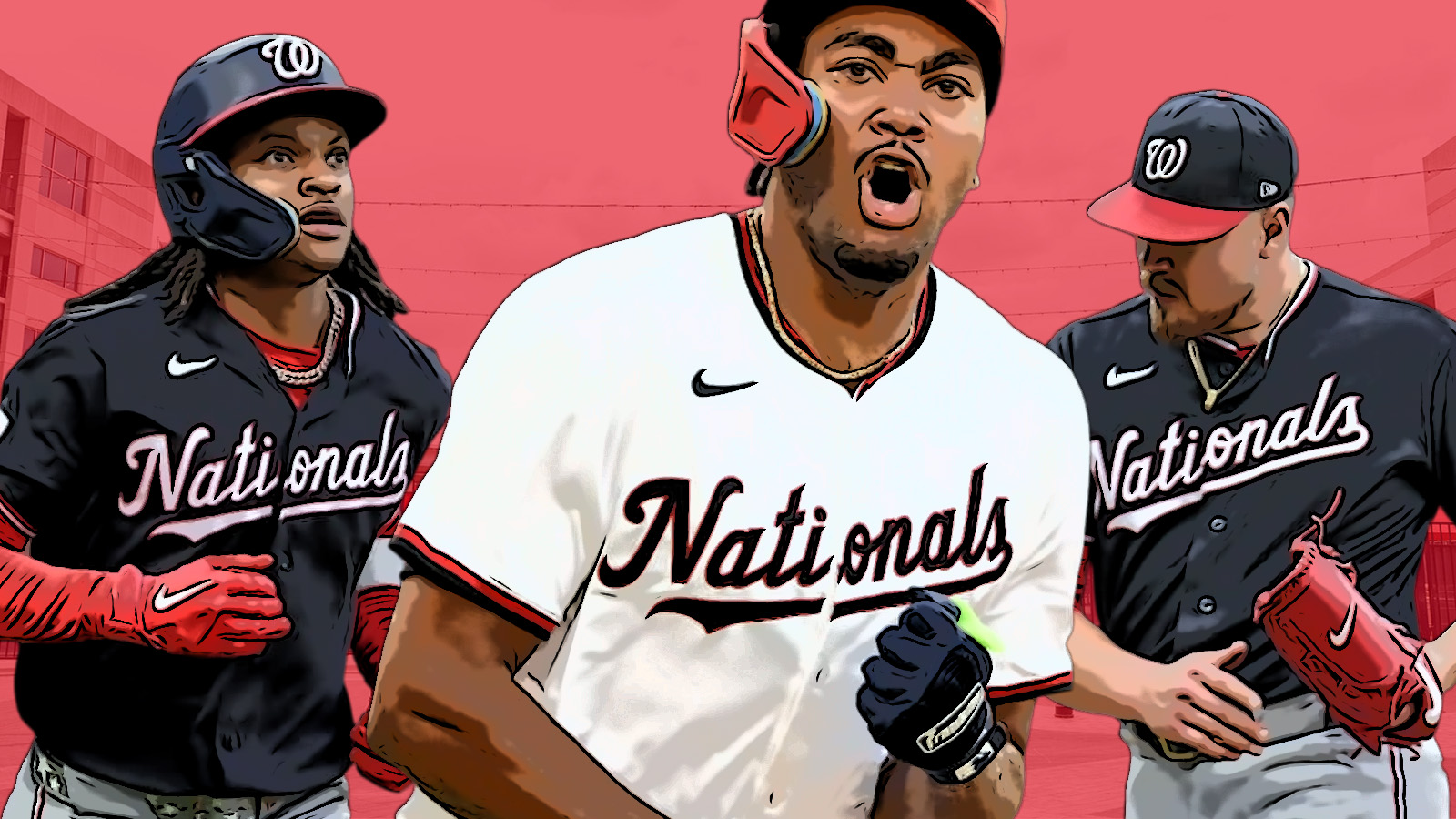
For what was a start of a new era in 2026, it certainly got off to a good start for the Nationals. Washington went 77-85, an 11-game improvement from 2025. Much of that success from Blake Butera’s first season can be attributed to an offense that took off.
The Offense
| Stat | Number | Rank |
|---|---|---|
| Runs Scored | 821 | 3rd |
| Home Runs | 210 | 6th |
| OPS | .744 | t-3rd |
| Whiff% | 25.1% | 14th |
| Hard Hit% | 39.1% | 14th |
The Pitching
| Stat | Number | Rank |
|---|---|---|
| Starters’ ERA | 4.37 | 20th |
| Relievers’ ERA | 4.99 | 28th |
| Strikeouts | 1283 | 24th |
| Whiff% | 23.0% | 26th |
| Chase% | 29.8% | 22nd |
The Good
One year after the Nationals sported one of baseball’s worst offenses from a statistical standpoint in 2025, things turned quickly in 2026. Washington’s offense finished in the top 10 in several categories, including two critical ones: home runs and runs scored.
Nationals fans finally saw the breakout year from CJ Abrams. Abrams finished with a career-best 33 home runs, as well as 67 extra-base hits that tied with Pete Alonso for seventh-most in the Majors. He was also one of three Nationals to hit at least 30 this season, joining James Wood and Luis Garcia Jr. (split 2026 with Washington and New York (AL)).
Abrams was making hard contact — and it usually went to the pull side — and doing so at a much larger pace, compared to past seasons. He also went off once June arrived, as Abrams’ 21 home runs from that point were among the top 20 most among MLB players. Additionally, he was one of 14 to accrue 15+ home runs and 10+ stolen bases over the final three months.

The Nationals also had another player in that group of 14, outfielder Daylen Lile. Lile, you may remember, had a torrid September 2025 that helped put him in the upper echelon of second-half hitters. Well, he did it again in 2026.
From June 1 onward, Lile slashed .244/.292/.441 with 15 home runs, 35 total extra-base hits, and 11 stolen bases. That run helped him finish tied for 31st in extra-base hits (58) on the season, in another campaign where he used all of his tools to help the Nats.

Wood had an impressive campaign, although yet again, the second-half numbers took a tumble. Over 38 games after the break, Wood slashed .229/.331/.319 (.651 OPS) with just two home runs and nine extra-base hits. It also didn’t help that the third-year outfielder missed a month in August with an oblique strain.
What also helped was the fact that the Nationals had depth beyond those three.
Jacob Young, who was recently extended by Washington, had a career-high 10 home runs for the Nats. And then, there were the corner infielders Curtis Mead and Luis Garcia Jr., both of whom were traded at the deadline but had career seasons before their departures.
Mead was acquired by the Nationals in late March, a move that proved to be fruitful. He set a career high in home runs (17) before he left Washington and expanded out of the zone on fewer occasions.
Garcia Jr., a long-time middle infielder for the Nationals, finally solved the first base problem — even though it didn’t last long. Before he was shipped up to the Yankees, Garcia Jr. hit 23 home runs for the Nationals.
Pitching was a haggle for the Nationals. However, there were some positives, including the emergence of Andrew Alvarez and Cade Cavalli.
Alvarez wound up being quite the hand down the stretch for the Nationals. From July 1 through the end of the season, Alvarez struck out 72 over 76, posted a strong 3.43 ERA, and only allowed five home runs. His .6 HR/9 was the 15th-lowest among starting pitchers with 40+ IP in that span.
Cavalli, meanwhile, became a 200-strikeout pitcher in 2026, a breakout campaign for the right-hander. It was an all-world effort from Cavalli, who checked all the boxes: showed the stuff, jammed hitters, and was able to use his fastballs to set up the secondary stuff.
Years after the Nationals’ previous regime took Cavalli in the first round, results were shown amidst a healthy campaign for him.
The Bad
The pitching staff was, very much, a mixed bag for the Nationals.
For one, the Nationals’ rotation didn’t have much in the way of pure swing-and-miss stuff, aside from Cavalli. In fact, much of that was concentrated among the relief core between the likes of Riley Cornelio, Clayton Beeter, and newcomer Luis Perales.

For much of 2027, the Nationals’ rotation was populated by the likes of Jake Irvin, Miles Mikolas, and Zack Littell. Irvin was a holdover from the old regime, while Littell and Mikolas were both short-term adds over the previous offseason.
Both Littell (between Arizona and Washington) and Mikolas finished with the two lowest K/9 rates in the Majors among starting pitchers. Irvin, who had a 5.48 ERA in 2026, conceded 20 home runs in 106.2 IP last season for Washington.
As for the bullpen, Washington cycled through a lot of relievers this season. Some, like Orlando Ribalta, Cornelio, Beeter, and Will Dion, proved to be highly valuable. Others, though, weren’t as productive.
Early Projected Lineup for 2027
- C: Harry Ford/Keibert Ruiz
- 1B: Abimelec Ortiz
- 2B: CJ Abrams
- 3B: Yohandy Morales
- SS: Nasim Nunez
- OF: Daylen Lile (LF), Jacob Young (CF), Dylan Crews (RF)
- DH: James Wood
- SP: Cade Cavalli, Connelly Early, Andrew Alvarez, DJ Herz, Josiah Gray
- RP: Clayton Beeter, Orlando Ribalta, Riley Cornelio, Reiver Sanmartin, Brad Lord, Will Dion, Erik Tolman
As we noted, the Nationals did come into the winter with an obvious need for pitching (the club made a move on November 6, adding Reiver Sanmartin). But how that gets solved will likely be through a mix of moves, coupled with relying on the hopes of some young pitchers to work themselves into the rotation.
Cavalli is the ace, and Connelly Early may very well prove to be a nice complement to him.
Moving to the offense, eyes will be on the left side of the infield.
Nasim Nunez is a plus runner and a good defender but he’s likely not the answer for the future. Seaver King, who had a great 2026 in the Minors, could be a solution next season.
Check out more of our MLB coverage.