
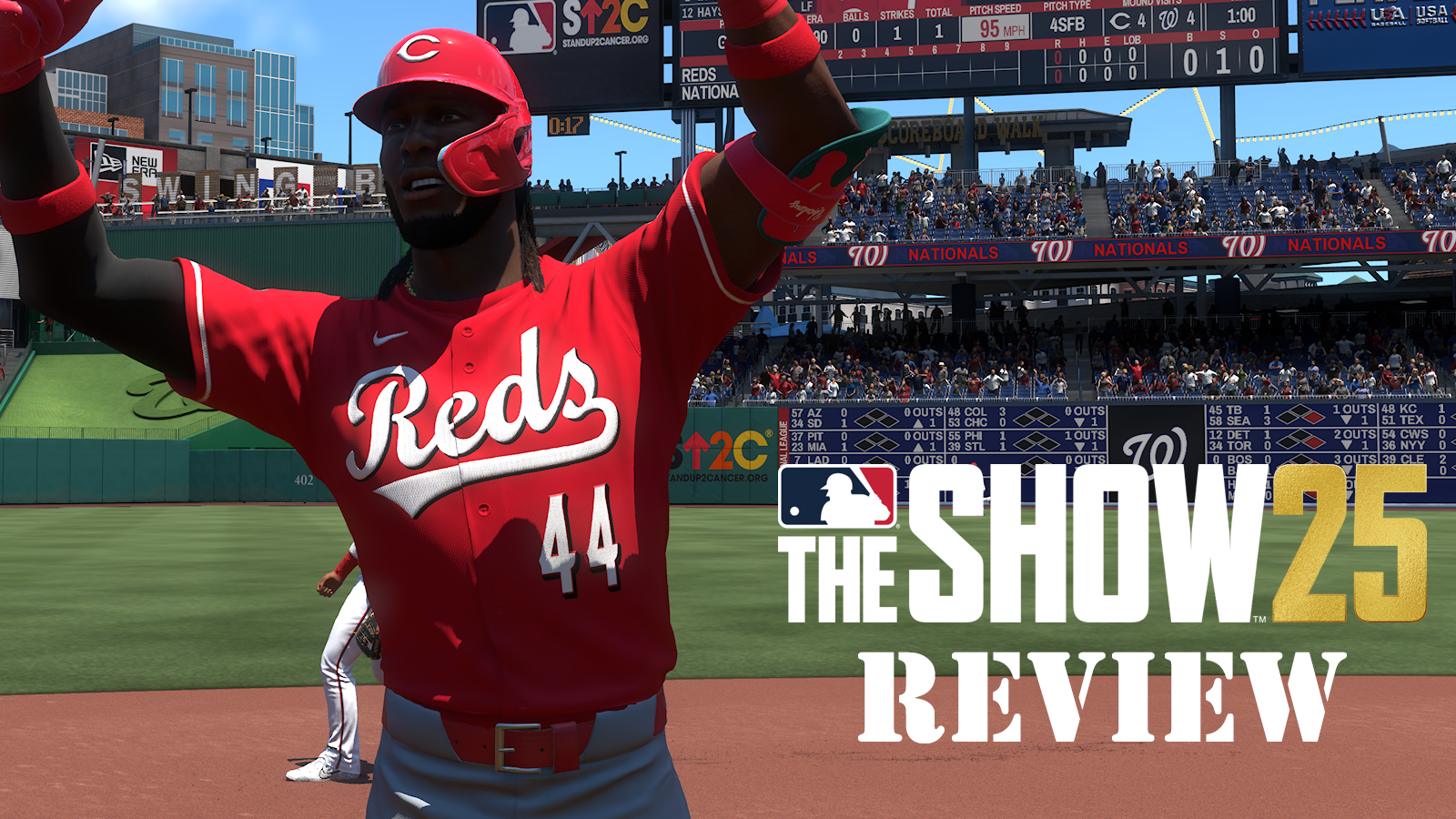
With 2025 in the books, we can take a look back in time at the year it was. From the video game standpoint, it was an interesting one to say the least. However, the year also provided a reset for San Diego Studios with MLB The Show 25. Now that the game’s lifecycle has reached its end, here’s our comprehensive review going over the good and the bad.
A gameplay shakeup
MLB The Show 24 was a slugfest, not in the literal sense. However, for those who played Diamond Dynasty — and this sentiment could apply to other modes, as well — the field felt smaller. Home runs were easier to hit, and in the online world, Shield Woods Park became everyone’s home field.
Things changed for 2025.
Let’s start with the hard gameplay changes and additions. For ’25, Sony San Diego’s most notable addition was Ambush Hitting. Ambush Hitting allowed players who use Zone to “guess” where the pitch would wind up. Guess correctly, and the size of the PCI would increase. Pick wrong, and it would shrink.

Now, before I get into my thoughts on Ambush, let me preface it with this: I’m not a casual MLB The Show player. I play it regularly, and was fortunate enough to make it to World Series rank in Diamond Dynasty almost every season (time permitting).
Aside from using it for achievement progress, I never used Ambush Hitting.
Ambush Hitting is a good, practical concept. Don’t get me wrong on that. However, there are flaws with it. One, the ball still needs to be pieced up with the inner PCI. Two, the Plate Coverage Indicator is already large enough on All-Star & lower, important since those are the most-used difficulties.
That doesn’t mean it’s not useful. It just wasn’t for me.
Second, Sony released a new difficulty, called G.OA.T. This difficulty is now the hardest difficulty in the game, surpassing Legend. However, it came with major issues.
The game became a swing-and-miss simulator on the difficulty, largely because of the PCI shrinkage that comes with sliders to same-sided hitters, including hanging sliders in the zone. Shrinkage was already a problem on Hall of Fame and Legend difficulties. G.OA.T. only further showed the problem with shrinkage.
Another talking point, particularly among those who love to interject online, was the lower exit velocities and barreled-up baseballs. And I have to admit, at some points, I found this aggravating. Why? Well, in a skill-based video game, it was frustrating to see poorly-hit contact hit the ground, while bullets found gloves.
Unfortunately, that is a part of baseball. How frequently that should happen is up for debate. Nonetheless, though, games in MLB The Show 24 felt like home run derbies. I understand the correction.
Before moving on, I am going to add one more point: I’ve seen enough Coors Field for one year.
Diamond Dynasty — same as it ever was (sort of)
After two years of experimenting with Sets, it was all over for MLB The Show 25.
This year, individuals could use any card at any time without needing to check what Set it belonged to. A novel concept.
It also meant that the early-game was filled with lower-tier Diamonds, making team building more of a challenge — not a bad thing.
Now, Diamond Dynasty didn’t truly return to its heyday from four years ago. Some tweaks made it different. Some for the better, and some for the worst.
Diamond Quest became an interesting new single-player game mode. It allowed players to acquire new cards and farm Stubs, even though the drop rates were frustrating.
Almost every card Series had a special item as a reward. Examples include the 89 New Threads Anthony Santander, and 99 OVR Finest Cal Raleigh. Traditionally, this would only be reserved for marquee Series (i.e., 42 Series from MLB 21).
This added a new layer to Diamond Dynasty, making almost every card matter. However, it came with downsides.

One, it increased the demand for innocuous cards. But two, Sony decided to make good on its promise of making packs more accessible in Programs, usually released in tandem with new Series, by releasing different tiers of packs. For ’25, there were Deluxe, Premium, and Ultra tiers. Plus, special insert cards for some Series.
It did make things more expensive. Does that mean everything was unattainable? No. But, it did make things tougher for lapsed and casual players, particularly in the early stages.
Another pain was the fact that Sony loved to release cards with bizarre attribute splits. Perhaps the most egregious example was this Topps Now Willi Castro, available in a Chase Pack. Take a look at the running attributes.

On the surface level, it felt like some cards, particularly those available only in packs, were being heavily manipulated. If anything, the cure to this would be to rework the Diamond Dynasty rating formula.
For Team Affinity, SDS decided to create a year-long grind called My Journey. My Journey forced players to complete team-based Missions to unlock Captain Cards. Aside from the endgame content, team boosts via the Team Affinity cards were the only ones available.
I didn’t dislike the new format. However, there were two issues. One, the path became unimportant after unlocking the Finest card. Two, SDS did correct this but it felt awfully long for content that felt underwhelming.
As for the good, Weekend Classic was very fun. It added a new layer of competition that the game was missing. In fact, it was more exciting than Ranked — by far.
Two, the content came at a reasonable pace. It allowed even casual players to catch up.
Three, it was good to see tradeable Inning Bosses once more. However, it felt like these bosses were always below the power curve of the meta.
Franchise
Franchise Mode continues to feel…underwhelming.
New to MLB The Show 26 was the addition of a “Big Board” in free agency, meaning that players had to woo potential free agents three at a time. It essentially copied off the scouting system, one that only allows looks at prospects three at a time.
I have to admit that I am more of an Out of the Park Baseball person, at least when it comes to management simulators. And, this past year’s Franchise Mode is a perfect example of why that is.
It feels too streamlined. The user is very limited with regard to how to scout, how to draft, and how to sign free agents. Additionally, it’s still too easy to trade.

Now, I am optimistic things will change. At the very least, the new AI lineup changes promised for ‘26 look appealing. However, the verdict on that will be determined next year.
Road to the Show
Sony blew up the old format for Road to the Show (RTTS), which became unnecessary after the ability to use a create-a-player (CAP) in Diamond Dynasty was removed in 2024.
New to MLB The Show 25 was a tweaked system that allowed players to grind 99 everything for attributes, unlock new Perks, and play in college. Yes, for those who didn’t play ‘25, Sony added several prestigious baseball programs, including Texas, LSU, and Tennessee.
This, at least when it was announced, felt like a game-changer. However, it wasn’t executed as such.
College in RTTS felt unnecessary. For one, players could only choose from a handful of universities and play in SDS’ version of the College World Series. But more importantly, the user would only get a handful of upgrade points, plus college-themed gear, for three years of experience. That’s it.

One would think that a potential high-end college player could wind up as a 70-75 OVR player who’s nearly on the cusp of the Majors. No, that’s not the case. Instead, the user still gets to do everything else that a high schooler could, including grinding through both Double-A and Triple-A at a low overall.
And aside from the college and attribute changes, nothing else was different. Requesting a trade is still a pain. The workouts are still the same. It felt like something was missing.
Quality control
Arguably, my biggest issue with MLB The Show 25 was quality control. Which affected functionality across all game modes and features.
Things started relatively sloppily, for those who remember. When the game was released, there were visual and audio glitches abound. For example, I found this hand-through-the-glove bug during early release.
Aside from that, there were technical bugs, including but not limited to: PCI Anchor resets, PAR not working as intended, and a years-long issue with avatars that have dreadlocks, which caused the framerate to drop. Many of these, though, were addressed.
However, there were several bugs left unaddressed or were unable to be fixed during this game’s lifecycle.
One was the wheel in the Diamond Dynasty home menu that showcased the attributes and overalls for cards. For some players, particularly those with Live Series cards, Flashbacks would have incorrect data.

The second, and perhaps most glaring issue, was custom stadiums.
When MLB The Show 25 first launched, stadiums ported over from past installments were not available. Eventually, Sony got it running in the spring, only for it to be shut down in May.
SDS quietly allowed players to start using these stadiums again, albeit with visual bugs. For example, some assets in the created stadiums would flicker.
Then, in the summer, Sony locked down the usage for created stadiums in online play after Lagrasa was added to the vault. Lagrasa took advantage of a wall exploit within Stadium Creator. It allowed players to use a stadium that had walls all over the field, resulting in uber-short home runs.

Plain and simple, things must be better for 2026.
Verdict
Even though MLB The Show 25 was flawed, it wasn’t a bad game.
Diamond Dynasty was a fun overall experience. And despite various frustrations with the gameplay, it felt more polished at launch than ’24.
However, for the individuals who don’t love Diamond Dynasty, you might have a different take.
Rating: 7/10
Check out more of our gaming coverage.